See the Bell Ringing at St Leonard’s page for some history of our bells, and about our ringing band…
History of St Leonard’s
By Ivor Porter, the son of the Revd. Leopold Victor Porter, who was Vicar of Keevil between 1943 and 1946
The road sinks down into the village between high banks and walls, so that if you turn up into the lane into the churchyard you come unexpectedly upon the clear view across the vale to the ramparts of Salisbury Plain. A thousand years ago there was already the “Coople Church” down there in the meadows its foundations now under grass. When the Normans came Arnulf of Hesdin planted a simple rectangular building on the higher ground from which our church has grown. He gave it to the Nuns of Shaftesbury when his daughter entered their order and the 13th Century lancet windows on either side of the choir are their legacy today.
By the 15th Century it had passed to the monks of Edington Priory who enlarged it and made it cruciform by adding north and south transepts and nave.
At the time of the Reformation, the wool merchants and clothiers added the south aisle and tower, thus completing the design of the Church as we know it today. The Victorians embellished it with good quality stained glass and in the present century a handsome Rood Screen was erected.
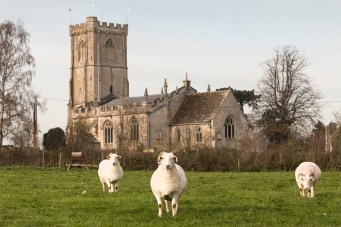 Throughout the generations the masons and craftsmen used methods and features such as the pinnacles which crown the walls which show our kinship with our neighbours in Steeple Ashton and Trowbridge but, like all good Parish Churches, we have our unique treasures. The roof beams with tracery panels above them are notable and the Sanctus Bell in its own little turret above the choir is one of the six oldest bells in the country. It was not cast in the usual way but turned on a lathe. Within there are fine monuments on the walls to 17th and 18th Century squires and their families and in the churchyard good box tombs for prosperous clothiers and farmers. On tombstones and the War Memorial are many names still familiar to us.
We are proud that for nearly a thousand years St Leonard’s has been the growing and living heart of this village. It would be a tragedy if it stopped beating through our neglect. The Church needs an ongoing commitment from everyone to keep it in existence.
From the Wiltshire and Swindon History Centre…
It is thought that there was an extremely early church within the parish, at around the end of the 11th century; a church, its tithes and lands were granted to Shaftesbury Abbey by the lord of the manor, Ernulf de Hesdin, when his daughter became a nun there. This church is thought to have originally stood where St Leonard’s now is, but evidence is scarce.
In 1393 the advowson of Keevil was sold by the Abbey of Shaftesbury to the Priory at Edington. It is presumed that the monks went swiftly about the business of building a new church.The church built by them was known as St Leonard’s by 1396. There were initially two chapels; one was known as the Lady Chapel.
St Leonard was the patron saint of prisoners and other churches within Wiltshire which share the name include Minety and Broad Blundson. He was born in Le Mans, in France, and died at Limoges in 559.
The church has a nave, chancel, north and south transepts, south aisle, west tower and three porches, facing north, west and south. The nave is especially interesting as it is irregular; one side is at least one foot shorter than the other, creating a slightly wonky effect. The chancel has two single windows.
There was an extension and enlargement of the church in the years 1516-1517. Some restoration occurred at the start of the 19th century; in 1807 the rood loft was taken down because of dry rot and in 1814 the pews were found to be rotten and were replaced. The altar floor was raised and the altar piece extracted in 1815 at a cost of £42.
In 1909 the organ was installed in the church for £300.
The font in the church is the original one, but took a leave of absence in19th century when it was replaced by a new creation. In 1840, the Reverend Crawley of Steeple Ashton found the font in a stonemason’s yard. He bought it and kept it in his garden for some time before giving it to the Reverend W.H. Pooke, who installed it back in its original position in St Leonard’s.
The churchyard was enlarged in 1864 and heating apparatus was installed in 1905 but the process took until 1909 to complete.
The east window is in memory of the Reverend G.T. Chamberlaine, who was a prominent member of the community. Two smaller windows in the church were the gift of the Wallington family; the first in 1901 and the second in 1905. The clock on the first floor of the tower has no hands. It is not clear exactly when it was built but was probably from around the turn of the 18th century. There are many mural tablets within the church, lots of them using coloured marble, and they commemorate local families such as the Blagden family of the 18th century.
In 1553 there were four bells and a Sanctus bell at St Leonard’s. The Sanctus bell at the church is thought to be one of the oldest in the country, dating from the 12th century. It was moulded on a lathe which is notable as the majority of later bells were cast. In March 1902, the tenor bell fell down, but as it was kept from falling too far by the wooden frame, no-one was injured. In the spring of 2000, the bells were taken down from the tower and sent for cleaning. In the meantime there was refurbishment of the cast iron frames and wooden wheels and installation of safety netting. The bells were re-hung on 13 September 2000.
The vicarage of St Leonard’s was built in 1842 by Rev. Pooke and was enlarged in 1869. It was also known as ‘Field Head’ and is now a private house.
A new vicarage was built in Steeple Ashton in 1953 and was the home of the resident vicar until sold by the Church Commissioners for England in June 1972. It is now a private dwelling known as ‘Springfield House’. Keevil last had a resident vicar in 1970; our current vicar resides in Trowbridge and also tends to St James’ Church there.
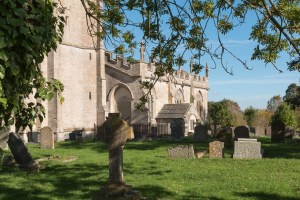 During a restoration in the later part of the 20th century, stone gargoyles clinging to the side of the church were considered to be in such a bad condition they would have to be removed. New gargoyles, at a cost of £20,000 were installed, but were purely decorative, unlike the originals which were a way of draining excess water from the church roof.
The church is a Grade II* listed building and there are several monuments in the graveyards which are Grade II listed. The parish registers from 1559 (christenings and marriages) and 1562 (burials), other than those in current use are held at the Wiltshire & Swindon History Centre at Chippenham.
 KEEVIL VILLAGE
Good morning, I have enjoyed reading this history of St Leonard’s- thank you.
My husband and I are travelling from Australia and are looking forward to visiting your wonderful church next month, in June 2022.
I think My 3 x great grandmother, Mercy Cox, was christened at St Leonard’s in 1805 and married William Porter there 1833. I think there might also be some Cox or Porter family buried in the church yard.
Kind regards,
Shaneen Smith
LikeLike
Thank you for the informative information on your beautiful church.
I wondered if you could help with a family tree brick wall. My husband’s antecedent ALEXANDER WILLMOTT c.1560 – 1597 married ALICE (Alyce) BLUNT on the 21st July 1584 in Keevil. I do not know which church unfortunately. Do you have any records please? I have also joined the Wiltshire Family History Society.
If you can help it would be most appreciated.
Maggie
LikeLiked by 1 person