Future Meetings:
- February TBC
Contact David or Kim Finch – 01380 871527; 07802 848823 £15 to £20 per person to cover costs.
FAQs
Q – Are the wines available in the UK?
A – Mostly yes! If not, then there’s a good reason to taste them anyway.
Q – Do you have to be a member to take part?
A – No. Anyone in the village and their close friends can come, but attendees do need to book places in advance and commit to the charge that pays for the wine, cheese, and artisan breads.
Q – Do you need to be a wine expert?
A – No, it helps if you like wine and are happy to chat with others. We all have different tastes and preferences.
Q – How do the tastings work?
A – We each have 3 tasting glasses – and during the evening we’ll sample 8 to 9 wines. That way we can keep some and compare it to others. We have water on the table and a container to pour away any wine we don’t like. Everyone has a tasting sheet to make whatever notes they like. Some do, some don’t.
September Tasting Notes – USA Wines
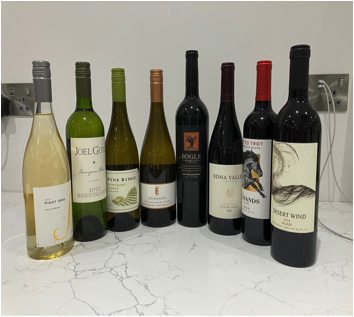
September’s theme was USA wines with 9 attendees. We went beyond the cheaper mass produced wines, and instead sampled 8 bottles (4 white; 4 red) each made by a different vineyard in either California or Washington State and using different grapes (and there was no Chardonnay!). 2 of the 4 reds were blends.
We started with a 2022 Pinot Gris by J Vineyards of California, which contained 13.6% alcohol by volume (abv). This was followed by the 2022 Sauvignon Blanc made by Joel Gott from Healdsburg California and with 13.9% abv. Wine spectator had awarded this 91 points (out of 100), and those attending generally preferred this.
Our 3rd white wine was a blend of Chenin Blanc and Viognier from Pine Ridge and also 2022. This was lighter at 12% abv but more expensive than the first 2. 4th came a wine sold by The Wine Society – Epiphany 2019 from Rodney’s vineyard Santa Barbara California. 13.5% abv. This was more like a French style wine and was made from Grenache Blanc grapes. At £17 it was the cheapest of the whites tasted.
We moved onto the reds next, and that also meant cheese and artisan breads. Our first red was a Pinot Noir by Edna Valley. 14% abv, this was no basic PN. It had some complexity along with more body that normally expected from this grape, and made a refreshing change. The price was good too at £14.99 and available at Majestic.
Wine 6 was good (!) and took the form of a 2021 Zinfandel from old vines at the Bogle family estate in California. 14.5% abv and cheap in America where this bottle was purchased at $13.05. But in the UK it would be £18.37 + P&P.
We moved on to wine 7 – “Hot to Trot” 2020 by 14 Hands Winery in Washington State. James Suckling gave this 91 points out of 100. Lovely smooth wine, full of flavour – it was a red blend, with no further details available.
Finally we reached the last bottle called “Desert Wind” 2018 from Washington state. 13.9%abv and sadly not available in the UK. That’s a real shame because this was a great wine (IMHO). The grapes were a real mix – 40% Merlot; 33% Syrah; 7% Cabinet Sauvignon; 6% Cabinet Franc; 4% Tempranillo; 4% Malbec; and 1% Petit Verdot.
Learning Facts Of The Month
- In the USA, you can buy wines made from the “Syrah” grape, but in Australia it would be known as “Shiraz” (wine 8). The Americans call a grape “Zinfandel” while Europeans call it “Primitivo” (wine 6).
- American wines are generally good, but relatively expensive. At least now, the 9 of us attending the tasting will have some idea of what to order if we’re ever in the USA for an evening meal.
- Washington State may be considered by some to be the cold north in the USA, but the UK is at a higher latitude than Washington so nearer the North Pole.
June Tasting Notes – Austrian Wines
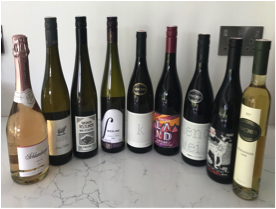
Austria is a little known, underrated, wine making country. David and Kim first discovered Austrian wines when they had the opportunity to go on an Austrian Wine Tasting Tour just before Covid struck.
In June, villagers tasted 9 wines – a sparkling rosé, white, red and dessert wines, from South of Vienna, Burgenland, Northern Rhone and Niederosterreich areas. A total cost of around £145.
With grape varieties specific to Austria:
- Gruner Veltliner
- Sankt Laurent
- Zweigelt
- Blaufrankisch
- Welschriesling
- Scheurebe
Another fun evening was had by all.
May Tasting Notes – Lebanese Wines
Our informal gatherings are about having fun, maybe learning a bit, trying wines we otherwise might not, making new friends.
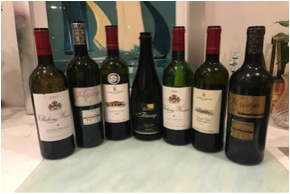
Wow, what a wonderful tasting – a Ukraine sparkling donated by an attendee and some amazing red wines from the Beqqa valley, Lebanon. We tasted 9 wines in total.The Ukrainian fizz was remarkable – good texture; a fine moose (bubbles on top); and a remarkable ability to retain fizz in the bottle once opened. £30
On to 2 whites – in the minority where the altitude, climate, and terroir favours reds. Both the Ksara Merwah and Kefraya Les Breteches were young, and flavourful. These benefitted from a little food. Both at £18.
Then came the reds.
First up was a slightly brown Massaya Silver 2005. The wine however was full in flavour, soft without any hint of being over the hill. Bought in 2010 at £16, you’d need to spend £32 today.
Two Domaine des Tourelles followed. The 2018 at £13 was compared to the 2017 grand cuvee at £21 – well worth the extra £8, but neither were competition for the Silver.
Next came three big reds.
A 2017 Chateau Musar at £36 – this was a bit “closed” and would benefit from more time in the bottle. The Massaya Gold Reserve 2005 was superb (£27 in 2010; now retails at £99) as was the Chateau Musar 2005 – bought at £43 in 2020 but now retails for £75.
These were stunning wines, made even better by the plates of cheese and artisan breads. Villagers will have the opportunity to try more Massaya wines later in 2024.
April Tasting Notes – New Zealand Wines
Our monthly informal gatherings are all about having some fun, maybe learning a bit from like-minded villagers, and over time experiencing wines that we might not otherwise try.
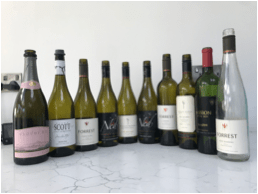
This time, we tasted 10 great wines (1 sparkling; 4 white; 4 red and a desert wine) all from either the Hawkes Bay (North Island) or Marlborough (South Island) regions of New Zealand.
We started with a welcoming and beautifully constructed sparkling Pelorus Rosé wine from Cloudy Bay (£27), before moving on to a dry 2022 Riesling wine from Alan Scott (£12.50). Light, clean and enticing. A 2022 Chenin Blanc by Forrest followed on – dryer than most CB grape wines and full of flavour too. Next came a surprising 2023 Sauvignon Blanc from the NED vineyard– fantastic value at £9, but the 5th wine from Craggy Range (also Sauvignon Blanc 2023) was, by majority decision, worth the extra £7 at £16. Wise guys had kept a little of the Forrest to provide a comparison (or poured a little more wine into 1 of their 3 glasses).
We then moved to the reds and the infamous “nibble break” with 6 speciality breads and 9 cheeses. We started the “reds” with a great NED Pinot Noir wine at £11. Great flavours for what can be a difficult grape to build into a good wine. The Forrest 2020 Legrein at £18 was a star for some, while others preferred the Craggy Range 2020 Te Kehu blend (£24) over the Mission 2019 Jewstone Antoine at £35 (!!)
Our final ( unusually 10th) wine was another by Forrest – a 2022 Petit Manseng (£14) which was part way between a sweet desert wine and a lovely aperitif. How? Well with an alcohol level of 10% you could easily quaff it (ed: All? Me: yes!) in the garden on a sunny afternoon.
Most agreed that the 2 NED wines were amazing value for money. While they lacked the complexity of the Craggy Range wines, their overall quality made them better than many wines from elsewhere of comparable price. All the wines tasted are available in the UK either from local retailers or on-line companies. Some had been bought in New Zealand in 2023 and so the prices quoted reflect current UK retail prices.
January Tasting Notes- South Africa
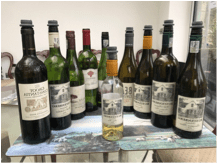
We started with a pairing of 2 wines made by Rustenberg – No. 1 was 2019 unoaked Sauvignon Blanc using cultured yeasts (£11.75 + delivery “D”), while No. 2 was a 2018 matured in oak barrels and fermented with wild live yeast (£12.15 +”D”).
Our 3rd wine was 2019 Rustenberg Rousanne grape (£16.95 +”D”). It had more of an oily texture than the first 2. Our 4th white wine was “Cecily” by the boutique winery Beau Constantia – a 2019 Viognier and was the first wine tasted with a traditional cork. This wine is not sold in the UK (US$32).
On to the reds (plus 9 cheese & 7 breads). The first – a bronze award winning 2016 Swartland Shiraz (£8 at Morrison’s – no longer sold). Most agreed this wasn’t good. We moved to bottle 6 – 2017 Klein Zalze blended wine using Shiraz, Grenache, and Viognier (Co-op price £9.25). That was much better – smooth, and well balanced. Next, was bottle 7 – Moerbei Directors Reserve, a Bordeaux blend from Stellenbosch (Naked Wines £13.00). Back then to Rustenberg for No. 8 with JM Nicholson 2016 (Majestic £14.99) – a good wine and the 20/21 is reputedly even better.
No. 9 was Constantia Rood 2017 from the famous and oldest South African Vineyard – Groot Constantia. The blend of Pinotage 34%, Merlot 30%, Shiraz 18% & 5 others (!!) produced a really likeable wine. Sadly not available in the UK but circa US$38 for 2018 and US$ 18 for the 2020.
The last wine was a “stickie”. Rustenberg 2019, with grapes dried on straw (81.5% Chenin Blanc; 18.5% Viognier) before fermentation – hence the intense flavours. £10 for 1/2 bottle, it’s no longer made.
Cheers!

 KEEVIL VILLAGE